
- The preponderance of thyroid neoplasms:
- Originate from the thyroid epithelial follicular cells:
- While 3% to 5% of neoplasms arise from the C cells or parafollicular cells
- Originate from the thyroid epithelial follicular cells:
- Differentiated thyroid cancer (DTC):
- Which derives from these follicular cells, includes:
- Papillary thyroid carcinoma (PTC)
- Follicular thyroid carcinoma (FTC)
- Oncocytic cell carcinoma (formerly known as Hürthle Cell Carcinoma / OCC)
- Poorly differentiated carcinoma
(insular carcinoma) - Anaplastic thyroid carcinoma (ACC / undifferentiated)
- These thyroid tumors comprise the majority, more than 90% of the cases, of all thyroid neoplasms
- Of all these subtypes, ATC is the rarest and is characterized by its extremely poor prognosis
- Likewise, poorly differentiated carcinoma is
characterized by its aggressive behavior and its unfavorable prognosis
- Which derives from these follicular cells, includes:
- Between the year 2010 and 2014:
- 63,229 patients per year were diagnosed with thyroid cancer:
- Of these 89.4% had PTC, 4.6% had FTC, 2.0% had OCC, 1.7% had medullary thyroid carcinoma (MTC), and 0.8% had ATC
- 63,229 patients per year were diagnosed with thyroid cancer:
- A follicular adenoma:
- Is a benign tumor (clonal neoplasm):
- That may serve as a precursor lesion for some follicular carcinomas
- Is a benign tumor (clonal neoplasm):
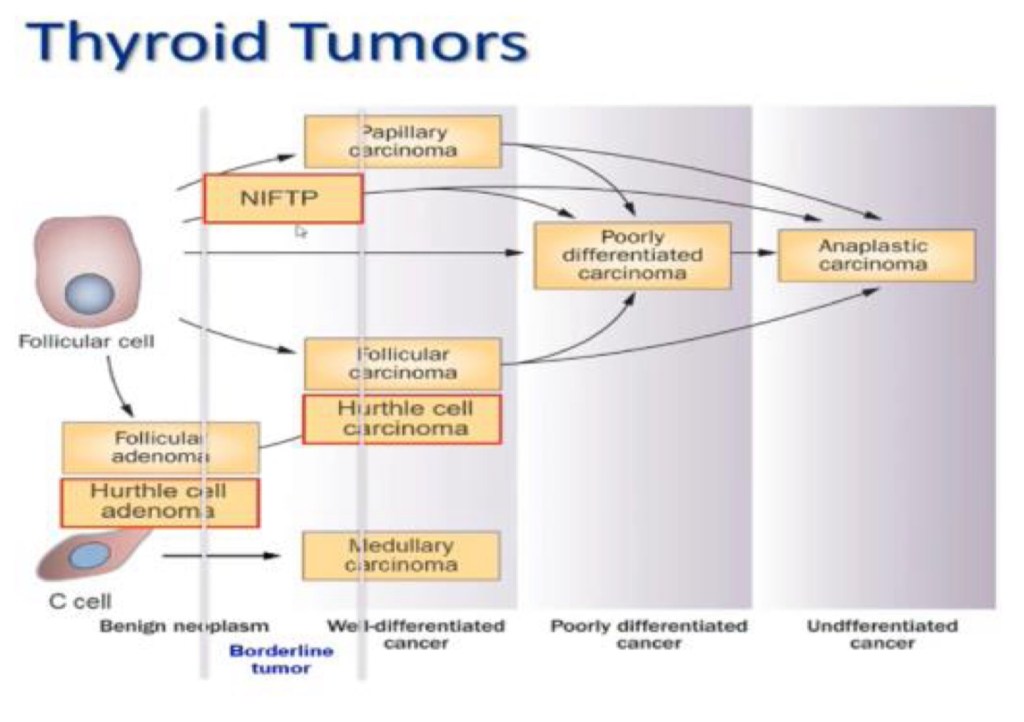
- Less-differentiated thyroid cancers, namely poorly differentiated carcinomas, and anaplastic carcinomas:
- Can develop de novo:
- Although many of them arise through the process of a stepwise dedifferentiation of papillary and follicular carcinomas (Figure)
- Can develop de novo:
- Thyroid nodules:
- Are a major health problem worldwide
- Studies have shown that the prevalence of palpable thyroid nodules:
- Is roughly 5% in women and 1% in men:
- Living in parts of the world with sufficient iodine
- Is roughly 5% in women and 1% in men:
- In contrast, high-resolution ultrasound:
- Can detect thyroid nodules in around 19% to 68% of randomly selected people:
- With higher frequencies in women and the elderly
- Can detect thyroid nodules in around 19% to 68% of randomly selected people:
- The clinical significance of thyroid nodules lies in the need to exclude thyroid cancer:
- Which occurs anywhere between 7% and 15% of the cases:
- Depending on age, gender, radiation exposure history, and family history
- Which occurs anywhere between 7% and 15% of the cases:
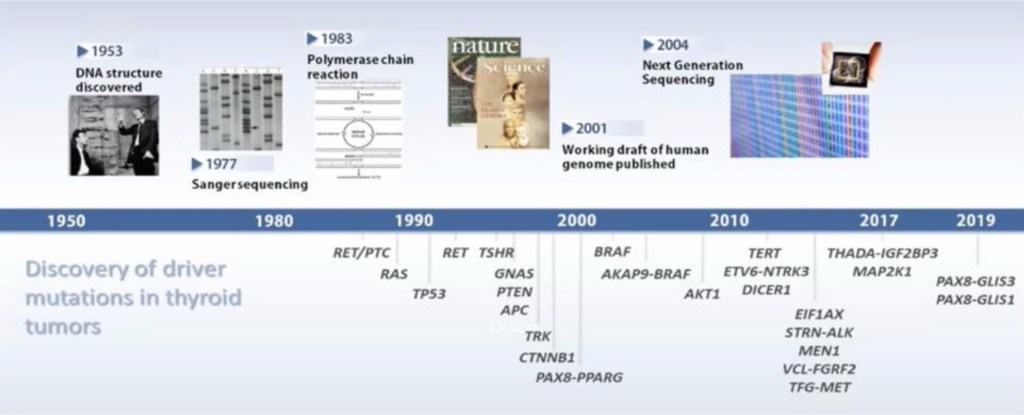
- The discovery in 1953 of the double helix structure of deoxyribonucleic acid (DNA), by James Watson and Francis Crick:
- Marked a milestone in the history of science and gave rise to modern molecular genetics that has
rapidly advanced and has help to identify the driver mutations in in many cancers, including thyroid neoplasms:- RET / PTC, RAS, TP53, RET, TSHR, GNAS, PTEN, APC, TRK, CTNNB1, PAX8-PPARG, BRAF, AKAP9-BRAF, AKT1, TERT, ETVS-NTRK3, DICER1, EIFF1AX, STRN-ALK, MEN1, VCL-FGRF2, TGF-MET, THADA-IGF2BP3, MAP2K1, PAX8-GLIS3, PAX8-GLIS1 (Figure)
- Marked a milestone in the history of science and gave rise to modern molecular genetics that has
- Analogous to other malignant neoplasms, the initiation and progression of thyroid cancer:
- Occurs through steady accumulation of multiple genetic and epigenetic alterations, including:
- Activating and inactivating somatic mutations
- Alteration in gene expression patterns
- MicroRNA (miRNA) dysregulation
- Aberrant gene methylation
- Occurs through steady accumulation of multiple genetic and epigenetic alterations, including:

 Rodrigo Arrangoiz MS, MD, FACS, FSSO