
- Palpable thyroid nodules increase in frequency throughout life:
- Reaching a prevalence of about 5% in the U.S. population for individuals ≥50 years having palpable thyroid nodules
- Nodules are even more prevalent when the thyroid gland is examined at autopsy or surgery, or when using ultrasonography:
- 50% of the thyroids studied have nodules:
- Which are almost always benign
- 50% of the thyroids studied have nodules:
- New nodules develop at a rate of about 0.1% per year:
- Beginning in early life
- They develop at a much higher rate (approximately 2% per year):
- After exposure to head and neck irradiation
- Thyroid nodules are approximately four times more common in individuals assigned female at birth (AFAB) than in individuals assigned male at birth (AMAB)
- By contrast, thyroid carcinoma is uncommon:
- For the U.S. population:
- The lifetime risk of being diagnosed with thyroid carcinoma is:
- 1.2%
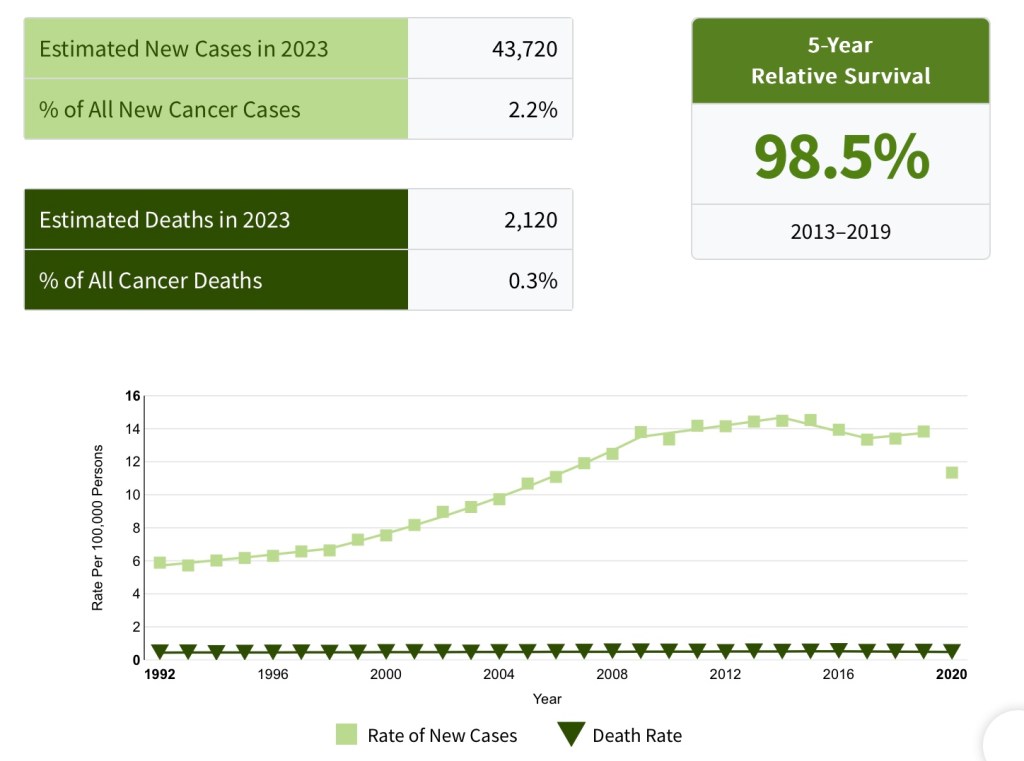
- It is estimated that approximately 43,720 new cases of thyroid carcinoma will be diagnosed in the United States in 2023
- As with thyroid nodules:
- Thyroid carcinoma occurs two to three times more often in individuals AFAB than in individuals AMAB
- Thyroid carcinoma is currently the seventh most common malignancy diagnosed in individuals AFAB
- The disease is also diagnosed more often in white North Americans than in African Americans
- The lifetime risk of being diagnosed with thyroid carcinoma is:
- The main histologic types of thyroid carcinoma are:
- Differentiated (including papillary, follicular, and oncocytic)
- Medullary
- Anaplastic:
- Which is an aggressive undifferentiated tumor
- Of 63,324 patients diagnosed with thyroid carcinoma from 2011 to 2015:
- 89.8% had papillary carcinoma
- 4.5% had follicular carcinoma
- 1.8% had oncocytic carcinoma
- 1.6% had medullary carcinoma
- 0.8% had anaplastic carcinoma
- For the U.S. population:
- A population-based study of data collected by the International Agency for Research on Cancer from 1998 to 2012:
- Showed that the global incidence of papillary thyroid carcinoma (PTC) increased during this time
- Mortality rates for thyroid carcinoma are, in general, very low
- Differentiated thyroid carcinomas usually have an excellent prognosis:
- With 10-year survival rates exceeding 90% to 95%
- In contrast, anaplastic thyroid carcinoma (ATC) is almost uniformly lethal
- However, since differentiated thyroid carcinomas represent more than 95% of all cases:
- Most thyroid carcinoma deaths are from:
- Papillary, follicular, and oncocytic carcinomas
- Most thyroid carcinoma deaths are from:
- In 2023, it is estimated that approximately 2120 cancer deaths will occur among persons with thyroid carcinoma in the United States
- Though thyroid carcinoma occurs more often in individuals AFAB:
- Mortality rates are lower for younger individuals AFAB
- Although the estimated incidence of thyroid carcinoma previously increased by an average of ~5% annually between 2004 and 2013:
- The incidence rate has more recently stabilized:
- Likely due to more conservative indications for thyroid biopsy and the reclassification of noninvasive follicular thyroid neoplasm with papillary-like nuclear features (NIFTP)
- Because overall mortality has not dramatically increased since 1975 (1150 vs. 2060 deaths):
- The previous increase in incidence may reflect, at least in part, earlier detection of subclinical disease (ie, small papillary carcinomas):
- However, data show the incidence has increased by varying degrees across all tumor sizes and age groups
- The stable age- and gender-adjusted mortality rate for thyroid carcinoma contrasts distinctly with the declining rates for other solid tumors in adults
- However, data show the incidence has increased by varying degrees across all tumor sizes and age groups
- The previous increase in incidence may reflect, at least in part, earlier detection of subclinical disease (ie, small papillary carcinomas):
- The incidence rate has more recently stabilized:
- A cohort study of 2000 to 2016 data from U.S. cancer registries:
- Showed an increase in incidence of aggressive PTC
- In addition, an analysis of 1992 to 2018 SEER data showed that there is no evidence of an improvement in disease-specific survival (DSS) in patients with distantly metastatic differentiated thyroid cancer

 Rodrigo Arrangoiz MS, MD, FACS, FSSO