

- Phyllodes tumors:Are true fibroepithelial neoplasms:With both epithelial and stromal components
-
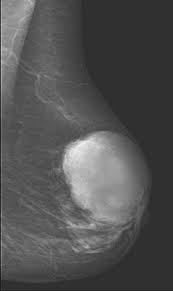
- They represent less than 1% of all breast tumors:Most commonly occurring in women in their 50sThey are rapidly growing tumors:But are usually well-defined / circumscribed:Often appear as distinct masses:Indistinguishable from fibroadenomas on mammography and ultrasound
-
-
- The World Health Organization has divided phyllodes tumors into three categories: BenignBorderline
- Malignant
- The World Health Organization has divided phyllodes tumors into three categories: BenignBorderline

-
- The majority of phyllodes tumors are benign:With local recurrence rates of 15% to 20% depending on adequacy of excision
- Grading is usually based on multiple criteria in the stromal component:Nuclear pleomorphismMitotic rate
- Stromal overgrowth
- Cellularity
- Tumor margins
- The distinction between cellular fibroadenomas and phyllodes tumors:Can be difficult
- The definition of “optimal” margin varies for various types of phyllodes tumors:Historically, margins of 2 cm to 3 cm have been recommended:But current recommendations are considerably less:With the only “absolute” being that the margin is tumor-free
- Malignant transformation:Is a rare occurrence
- Metastases can occur:In a small number of malignant phyllodes tumors and an even smaller number of borderline phyllodes tumors
- Radiotherapy may be of benefit for local control of malignant phyllodes tumors
- Differences in grading of phyllodes tumors among pathologists can be substantial
REFERENCES
- Barth RJ Jr, Wells WA, Mitchell SE, et al. A prospective, multi-institutional study of adjuvant radiotherapy after resection of malignant phyllodes tumors. Ann Surg Oncol. 2009;16:2288-2294.
- Lawton TJ, Acs G, Argani P, et al. Interobserver variability by pathologists in the distinction between cellular fibroadenomas and phyllodes tumors. Int J Surg Pathol. 2014;22:695-698.
- O’Malley F, Pinder S, Mulligan A, eds.. Fibroepithelial lesions, including fibroadenoma and phyllodes tumors. In: Breast pathology: a volume in the series: foundations in diagnostic pathology, 2nd ed. Philadelphia, PA: Elsevier Saunders; 2011:121-138.
- Pezner RD, Schultheiss TE, Paz IB. Malignant phyllodes tumor of the breast: local control rates with surgery alone. Int J Radiat Oncol Biol Phys. 2008;71:710-713.
- Sinn H, Kreipe H. A brief overview of the WHO classification of breast tumors, 4th edition, focusing on issues and updates from the 3rd edition. Breast Care (Basel). 2013;8:149-154.
- Spitaleri G, Toesca A, Botteri E, et al. Breast phyllodes tumor: a review of literature and a single center retrospective series analysis. Crit Rev Oncol Hematol. 2013;88 :427-436.

👉Member of the American Society of Breast Surgeons:


 Rodrigo Arrangoiz MS, MD, FACS, FSSO