
- Inflammatory breast cancer (IBC):
- Is a clinical diagnosis defined by the American Joint Committee on Cancer as a:
- Diffuse erythema and edema involving approximately a third or more of the skin of the breast:
- It is staged cT4d
- Diffuse erythema and edema involving approximately a third or more of the skin of the breast:
- A punch biopsy of the skin:
- Demonstrates tumor emboli within dermal lymphatics:
- Approximately 75% of the time
- A negative skin biopsy does NOT preclude the diagnosis:
- As it is clinical
- Demonstrates tumor emboli within dermal lymphatics:
- The appearance may lead to misdiagnosis of mastitis or breast cellulitis
- The rapid evolution of symptoms (within 3 to 6 months):
- Distinguishes IBC from a locally advanced breast cancer with associated edema
- Is a clinical diagnosis defined by the American Joint Committee on Cancer as a:
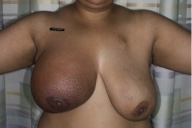
- IBC is rare:
- Present in 2% to 4% of breast cancer patients:
- Although the reported annual incidence has been increasing
- The tumor biology is disproportionately ER negative and HER2 amplified, compared with non-IBC
- Present in 2% to 4% of breast cancer patients:
- Patients should be evaluated in a multidisciplinary setting for trimodal therapy:
- Treatment should be initiated with neoadjuvant chemotherapy:
- Followed by aggressive local therapy
- The majority of patients with IBC:
- Present with clinical lymph node involvement
- Sentinel lymph node biopsy is not reliable in IBC:
- Due to blockage of dermal lymphatics:
- Thus axillary dissection should be performed
- Due to blockage of dermal lymphatics:
- Following neoadjuvant chemotherapy:
- Modified radical mastectomy is the appropriate surgery:
- Skin should not be spared:
- So as not to leave behind residual disease:
- Immediate reconstruction should be avoided
- So as not to leave behind residual disease:
- Skin should not be spared:
- Patients should receive post-mastectomy radiation to the skin, chest wall, and regional lymph nodes following surgery to optimize local control
- Modified radical mastectomy is the appropriate surgery:
- Treatment should be initiated with neoadjuvant chemotherapy:
- Survival in IBC has improved with trimodal therapy:
- A recent analysis of Surveillance, Epidemiology, and End Results data:
- Evaluated 10,197 patients with non-metastatic IBC between 1998 and 2010
- Patients who underwent trimodal therapy had improved 5- and 10-year survival:
- 55.4% and 37.3% over those that did not receive all 3 modalities
- Survival was lowest at 10 years (16.5%) for patients who underwent surgery alone
- A recent analysis of Surveillance, Epidemiology, and End Results data:
- References
- Amin MB, Edge S, Greene F, et al., eds. AJCC Cancer Staging Manual. 8th ed. New York, NY: Springer; 2017
- Hance KW, Anderson WF, Devesa SS, Young HA, Levine PH. Trends in inflammatory breast carcinoma incidence and survival: the surveillance, epidemiology, and end results program at the National Cancer Institute. J Natl Cancer Inst 2005;97(13):966-975.
- NCCN clinical practice guidelines in oncology. National Comprehensive Cancer Network. www.nccn.org/professionals/physician_gls/f_guidelines.asp. Accessed August 25, 2019.
- Menta A, Fouad TM, Lucci A, et al. Inflammatory breast cancer: what to know about this unique, aggressive breast cancer. Surg Clin North Am. 2018;98(4):787-800.
- Rueth NM, Lin HY, Bedrosian I, et al: Underuse of trimodality treatment affects survival for patients with inflammatory breast cancer: an analysis of treatment and survival trends from the National Cancer Database. J Clin Oncol. 2014;32(19):2018-2024.

 Rodrigo Arrangoiz MS, MD, FACS, FSSO