
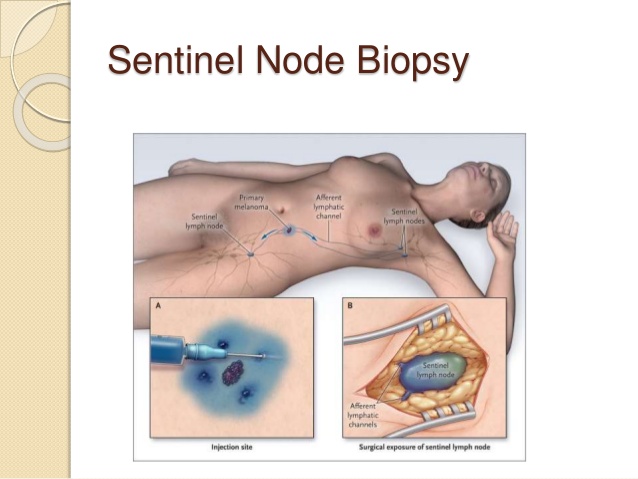
- Axillary SLNB:
- Remains the standard of care in the staging of clinically node-negative patients,:
- And is endorsed in the 2014 update of the American Society of Clinical Oncology clinical practice guidelines.
- Remains the standard of care in the staging of clinically node-negative patients,:
- For patients undergoing neoadjuvant chemotherapy:
- The optimal timing of SLNB (pre- or postchemotherapy) is debated:
- Concerns regarding performance of SLNB after neoadjuvant chemotherapy:
- Have historically centered around the ability to both identify a sentinel node and the sensitivity of the SLNB to predict non-SLN involvement:
- Particularly among clinically node-positive patients:
- Whose lymphatic pathways may be occluded by tumor and/or scarring resultant from chemotherapy.
- Particularly among clinically node-positive patients:
- However, over the past 10 years, a number of prospective studies have shown:
- A high accuracy of SLNB in the postneoadjuvant setting in patients presenting as clinically node negative prior to receiving neoadjuvant chemotherapy.
- Proponents of SLNB subsequent to neoadjuvant chemotherapy tout the fact that:
- This spares the patient another surgical procedure and that SLN posttreatment is more meaningful for predicting prognosis.
- In a small, early study published in 2000:
- 51 patients (postneoadjuvant chemotherapy) underwent SLNB followed by completion ALND:
- SLN identification rate was high at 94%
- The false-negative rate was low at 5.8%
- 51 patients (postneoadjuvant chemotherapy) underwent SLNB followed by completion ALND:
- In 2008, the Austrian Sentinel Node Study group published their results on 167 neoadjuvant chemotherapy patients who underwent postchemotherapy SLNB followed by completion ALND:
- SLNB was only offered to those with clinically negative nodes after chemotherapy
- SLN identification rate was:
- Highest with use of both vital blue dye and radiocolloid:
- 88% identification with dual tracer
- False-negative rate of the SLNB was:
- Only 8%
- Highest with use of both vital blue dye and radiocolloid:
- In the larger, multicenter National Surgical Adjuvant Breast and Bowel Project (NSABP) B-27 trial:
- 428 patients underwent SLNB before a required ALND
- Successful identification of a SLN was again high:
- 89% if radiocolloid was used:
- The 10% false-negative rate comparable to the rate observed for prechemotherapy SLNB in multicenter studies
- 89% if radiocolloid was used:
- If SLNB is performed and the SLN(s) is positive prior to neoadjuvant chemotherapy:
- A SLNB should not be repeated subsequent to chemotherapy:
- The large, multicenter SENTinel NeoAdjuvant (SENTINA) trial:
- Arm B demonstrated that in this setting, identification rates were:
- Low (61%)
- False-negative rates unacceptably high (52%)
- Arm B demonstrated that in this setting, identification rates were:
- The large, multicenter SENTinel NeoAdjuvant (SENTINA) trial:
- A SLNB should not be repeated subsequent to chemotherapy:
- Have historically centered around the ability to both identify a sentinel node and the sensitivity of the SLNB to predict non-SLN involvement:
- Concerns regarding performance of SLNB after neoadjuvant chemotherapy:
- The optimal timing of SLNB (pre- or postchemotherapy) is debated:

👉Rodrigo Arrangoiz MS, MD, FACS cirujano oncology y cirujano de mamá de Sociedad Quirúrgica S.C en el America British Cowdray Medical Center en la ciudad de Mexico:
-
Es experto en el manejo del cáncer de mama.

👉Es miembro de la American Society of Breast Surgeons:

Training:
• General surgery:
• Michigan State University:
• 2004 al 2010

• Surgical Oncology / Head and Neck Surgery / Endocrine Surgery:
• Fox Chase Cancer Center (Filadelfia):
• 2010 al 2012

• Masters in Science (Clinical research for health professionals):
• Drexel University (Filadelfia):
• 2010 al 2012

• Surgical Oncology / Head and Neck Surgery / Endocrine Surgery:
• IFHNOS / Memorial Sloan Kettering Cancer Center:
• 2014 al 2016


#Arrangoiz
#Surgeon
#Cirujano
#SurgicalOncologist
#CirujanoOncologo
#BreastSurgeon
#CirujanodeMama
#CancerSurgeon
#CirujanodeCancer
- References:
- Breslin TM, Cohen L, Sahin A, et al. Sentinel lymph node biopsy is accurate after neoadjuvant chemotherapy for breast cancer. J Clin Oncol. 2000;18:3480-3486.
- Kuehn T, Bauerfeind I, Fehm T, et al. Sentinel-lymph-node biopsy in patients with breast cancer before and after neoadjuvant chemotherapy (SENTINA): a prospective, multicentre cohort study. Lancet Oncol. 2013;14:609-618.
- Mamounas EP, Brown A, Anderson S, et al. Sentinel node biopsy after neoadjuvant chemotherapy in breast cancer: results from National Surgical Adjuvant Breast and Bowel Project Protocol B-27. J Clin Oncol. 2005;23:2694-2702.
- Tan VKM, Goh BKP, Fook-Chong S, et al.The feasibility and accuracy of sentinel lymph node biopsy in clinically node-negative patients after neoadjuvant chemotherapy for breast cancer—a systematic review and meta-analysis. J Surg Oncol. 2011;104:97-103.
- Tausch C, Konstantiniuk P, Kugler F, et al; Austrian Sentinel Node Study Group. Sentinel lymph node biopsy after preoperative chemotherapy for breast cancer: findings from the Austrian Sentinel Node Study Group. Ann Sur Oncol. 2008;15:3378-3383.
- van Deurzen CH, Vriens BE, Tjan-Heijnen VC, et al. Accuracy of sentinel node biopsy after neoadjuvant chemotherapy in breast cancer patients: a systematic review. Eur J Cancer. 2009;45:3124-3130.
- Xing Y, Foy M, Cox DD, et al. Meta-analysis of sentinel lymph node biopsy after preoperative chemotherapy in patients with breast cancer. Br J Surg. 2006;93:539-546.

 Rodrigo Arrangoiz MS, MD, FACS, FSSO