
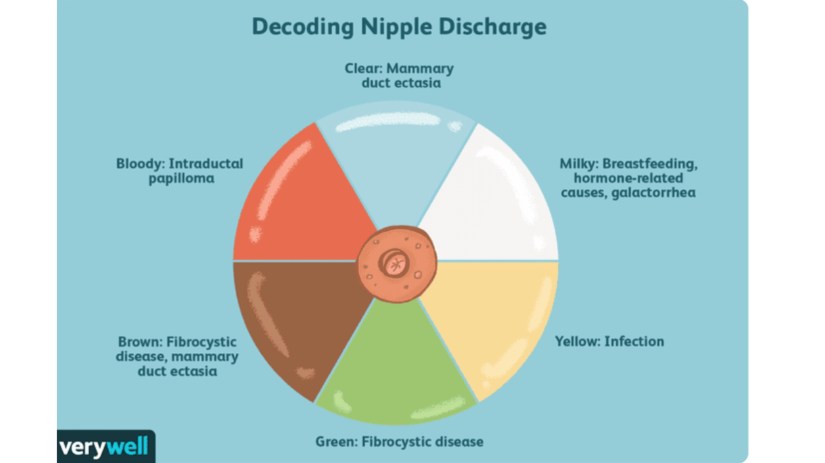
- Bloody nipple discharge:
- May occur in up to 20% of pregnancies.
- Although disconcerting and warranting evaluation, it is generally self-limited and benign:
- A history and physical examination is required:
- Ultrasound examination should be ordered.
- A history and physical examination is required:
- Epithelial proliferation and hypervascularity:
- Are common during pregnancy and become most pronounced during the second and third trimesters.
- If bloody nipple discharge:
- Persists 1 to 2 months after delivery:
- Further intervention would be warranted.
- Persists 1 to 2 months after delivery:
- REFERENCES
- Lafreniere R. Bloody nipple discharge during pregnancy: a rationale for conservative treatment. J Surg Oncol. 1990;43:228-230.
- Scott-Conner CE, Schorr SJ. The diagnosis and management of breast problems during pregnancy and lactation. Am J Surg. 1995;170:401-405.
 👉Rodrigo Arrangoiz MS, MD, FACScirujano oncology y miembro de Sociedad Quirúrgica S.C en el America British Cowdray Medical Center en la ciudad de Mexico:
-
Es experto en el manejo del patología de mama:

Training:
• General surgery:
• Michigan State University:
• 2004 al 2010

• Surgical Oncology / Head and Neck Surgery / Endocrine Surgery:
• Fox Chase Cancer Center (Filadelfia):
• 2010 al 2012

• Masters in Science (Clinical research for health professionals):
• Drexel University (Filadelfia):
• 2010 al 2012

• Surgical Oncology / Head and Neck Surgery / Endocrine Surgery:
• IFHNOS / Memorial Sloan Kettering Cancer Center:
• 2014 al 2016



 Rodrigo Arrangoiz MS, MD, FACS, FSSO