
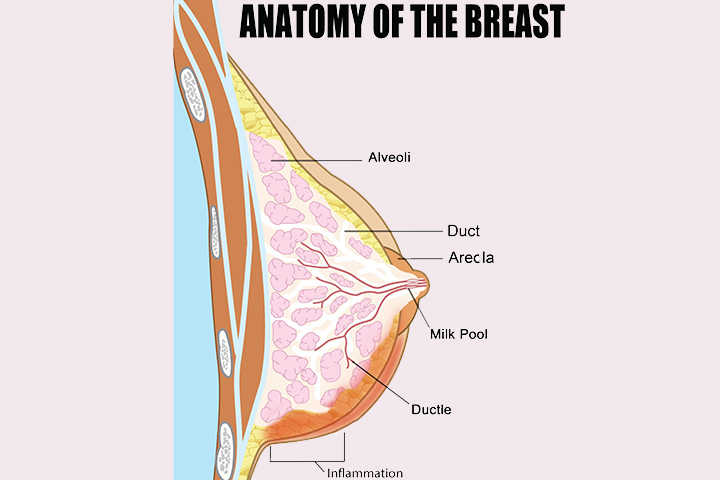
A 53-year-old postmenopausal woman presents with recurrent, spontaneous, single duct, bloody discharge from the left nipple over the last three weeks. You evaluate her and find no palpable abnormality, but confirm blood from a single duct. Mammogram and ultrasound are both normal.
- This patient has evidence of pathologic (not physiologic) nipple discharge:
- As it presents from a:
- Single duct
- Unilateral
- Is spontaneous
- Bloody, or serous
- As it presents from a:
- Physiologic nipple discharge:
- Can be green or white
- Bilateral
- From multiple ducts
- POresent only with manual expression of the breast
- When pathologic discharge is present:
- The most common etiology remains:
- A benign intraductal papilloma.
- The most common etiology remains:
- Mammography in this setting:
- Is limited by its low sensitivity for intraductal lesions
- Ultrasound in conjunction with mammography:
- Can improve sensitivity for intraductal masses:
- But imaging alone cannot reliably distinguish benign from malignant lesions
- Can improve sensitivity for intraductal masses:
- When imaging identifies an abnormal finding in the setting of nipple discharge:
- Needle biopsy:
- Is helpful to determine etiology and guide future excision
- Needle biopsy:
- When imaging work-up is otherwise negative:
- Investigators have attempted to identify patients with nipple discharge in whom operation can be avoided:
- One study showed 192 patients with unilateral, spontaneous, bloody, or serous nipple discharge and a normal mammogram:
- Had a less than 3% chance of malignancy:
- When they had a normal subareolar ultrasound as well:
- No patient had a cancer, but the numbers were small
- When they had a normal subareolar ultrasound as well:
- Had a less than 3% chance of malignancy:
- On the other hand, a separate study found conflicting results:
-
- As researchers identified cancer:
- In 10% of patients who had normal physical examination, mammography, and ultrasound
- The same group found that when additional evaluation was done:
- With cytology, ductography, or MRI:
- 7% (19/287) of patients were still diagnosed with cancer on duct excision
- With cytology, ductography, or MRI:
- As researchers identified cancer:
-
- One study showed 192 patients with unilateral, spontaneous, bloody, or serous nipple discharge and a normal mammogram:
- Investigators have attempted to identify patients with nipple discharge in whom operation can be avoided:
- Ductogram is a challenging technique that requires breast imaging expertise:
- It is often helpful in localizing an intraductal lesion and guiding percutaneous vacuum-assisted or surgical removal:
- But it does not reliably exclude a malignant lesion
- It is often helpful in localizing an intraductal lesion and guiding percutaneous vacuum-assisted or surgical removal:
- Negative imagin:
- Does not obviate the need for surgical excision in a woman with:
- Spontaneous, unilateral, single duct, bloody nipple discharge
- Does not obviate the need for surgical excision in a woman with:
- The standard management for unilateral bloody nipple discharge that is without an imaging abnormality therefore remains:
- Duct excision that is selective of the offending duct or as a major duct excision
- When a retroareolar imaging abnormality is identified in the setting of nipple discharge:
- It should be localized and removed.
- References:
- Ashfaq A, Senior D, Pockaj BA, et al. Validation study of a modern treatment algorithm for nipple discharge. Am J Surg. 2014;208:222-227.
- Gray RJ, Pockaj BA, Karstaedt PJ. Navigating murky waters: a modern treatment algorithm for nipple discharge. Am J Surg. 2007;194:850-854; discussion 854-855.
- Morrogh M, Morris EA, Liberman L, et al. The predictive value of ductography and magnetic resonance imaging in the management of nipple discharge. Ann Surg Oncol. 2007;12:3369-3377.
- Morrogh M, Park A, Elkin EB, et al. Lessons learned from 416 cases of nipple discharge of the breast. Am J Surg. 2010;200:73-80.
#Arrangoiz
#Surgeon
#BreastSurgeon
#CancerSurgeon

 Rodrigo Arrangoiz MS, MD, FACS, FSSO