
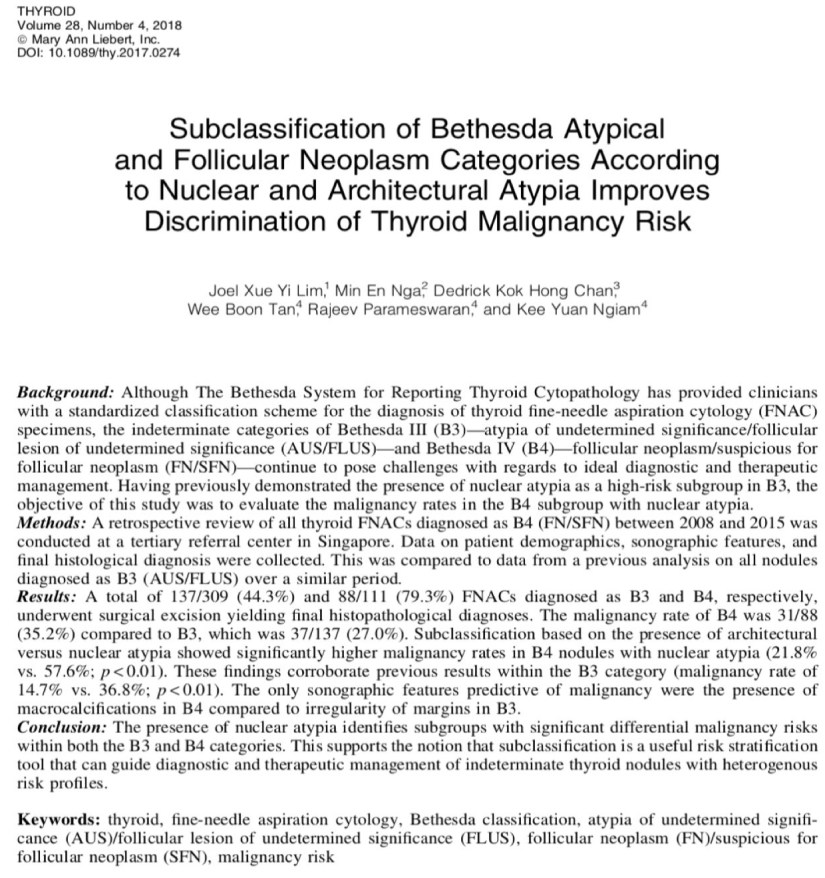
- Background:
- Although The Bethesda System for Reporting Thyroid Cytopathology has provided clinicians with a standardized classification scheme for the diagnosis of thyroid fine-needle aspiration cytology (FNAC) specimens, the indeterminate categories of Bethesda III (B3)—atypia of undetermined significance/follicular lesion of undetermined significance (AUS/FLUS)—and Bethesda IV (B4)—follicular neoplasm/suspicious for follicular neoplasm (FN/SFN)—continue to pose challenges with regards to ideal diagnostic and therapeutic management. Having previously demonstrated the presence of nuclear atypia as a high-risk subgroup in B3, the objective of this study was to evaluate the malignancy rates in the B4 subgroup with nuclear atypia.Methods: A retrospective review of all thyroid FNACs diagnosed as B4 (FN/SFN) between 2008 and 2015 was conducted at a tertiary referral center in Singapore. Data on patient demographics, sonographic features, and final histological diagnosis were collected. This was compared to data from a previous analysis on all nodules diagnosed as B3 (AUS/FLUS) over a similar period.
- Results:
- A total of 137/309 (44.3%) and 88/111 (79.3%) FNACs diagnosed as B3 and B4, respectively, underwent surgical excision yielding final histopathological diagnoses. The malignancy rate of B4 was 31/88 (35.2%) compared to B3, which was 37/137 (27.0%). Subclassification based on the presence of architectural versus nuclear atypia showed significantly higher malignancy rates in B4 nodules with nuclear atypia (21.8% vs. 57.6%; p < 0.01). These findings corroborate previous results within the B3 category (malignancy rate of 14.7% vs. 36.8%; p<0.01). The only sonographic features predictive of malignancy were the presence of macrocalcifications in B4 compared to irregularity of margins in B3.
- Conclusion:
- The presence of nuclear atypia identifies subgroups with significant differential malignancy risks within both the B3 and B4 categories. This supports the notion that subclassification is a useful risk stratification tool that can guide diagnostic and therapeutic management of indeterminate thyroid nodules with heterogenous risk profiles.
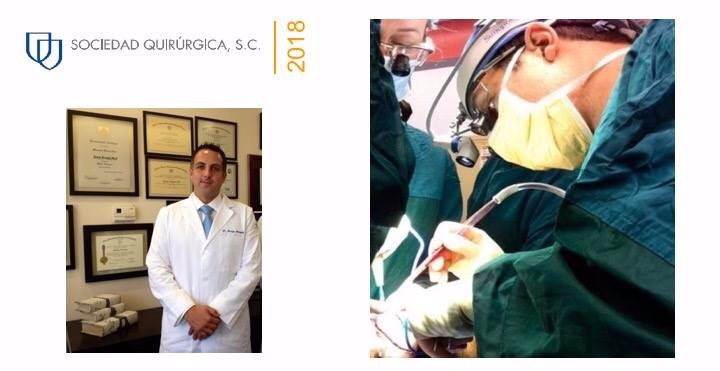
Rodrigo Arrangoiz MS, MD, FACS a head and neck surgeon / endocrine surgeon / surgical oncologist and is a member of Sociedad Quirúrgica S.C at the America British Cowdray Medical Center in Mexico City:
-
He is an expert in the management thyroid diseases.
-
Training:
• General surgery:
• Michigan State University:
• 2004 al 2010

• Surgical Oncology / Head and Neck Surgery / Endocrine Surgery:
• Fox Chase Cancer Center (Filadelfia):
• 2010 al 2012

• Masters in Science (Clinical research for health professionals):
• Drexel University (Filadelfia):
• 2010 al 2012

• Surgical Oncology / Head and Neck Surgery / Endocrine Surgery:
• IFHNOS / Memorial Sloan Kettering Cancer Center:
• 2014 al 2016

#Arrangoiz#Teacher
#Surgeon
#Cirujano
#ThyroidExpert
#ThyroidSurgeon
#CirujanodeTiroides
#ExpertoenTiroides
#ExpertoenParatiroides
#Paratiroides
#Hiperparatiroidismo
#CancerdeTiroides
#ThyroidCancer
#PapillaryThyroidCancer

 Rodrigo Arrangoiz MS, MD, FACS, FSSO