
- The superior parathyroid gland (PIV):
- Because of the limited embryologic migration:
- The PIVs are relatively constant in their position.
- In more than 80% of the cases:
- The PIVs are located on the posterior aspect of the thyroid lobe:
- In an area 2 cm in diameter centered 1 cm above the intersection of the inferior thyroid artery and the recurrent laryngeal nerve:
- In strict proximity with the cricothyroid junction (i.e., the junction of the cricoid cartilage and thyroid cartilage).
- In an area 2 cm in diameter centered 1 cm above the intersection of the inferior thyroid artery and the recurrent laryngeal nerve:
- The PIVs are located on the posterior aspect of the thyroid lobe:
- The PIV often has a surrounding halo of fat and is freely mobile on the thyroid capsule:
- The surrounding fat may represent atrophic thymic tissue originating from the ventral diverticulum.
- Occasionally, the PIVs are closely associated to the thyroid capsule:
- In about 15% of the cases:
- The PIVs are located on the posterolateral surface of the superior thyroid pole:
- Hidden between the layers of perithyroidal fascia:
- In such cases, it is bound on the posterolateral aspect of the thyroid lobe and is therefore less mobile.
- Hidden between the layers of perithyroidal fascia:
- The PIVs are located on the posterolateral surface of the superior thyroid pole:
- In about 15% of the cases:
- The PIV could also be located further in a caudal position:
- Sometimes partially obscured by the recurrent laryngeal nerve, inferior thyroid artery, or tubercle of Zuckerkandl.
- They may be found even further down:
- At a considerable distance posterior to the lower thyroid pole.
- Because of the limited embryologic migration:
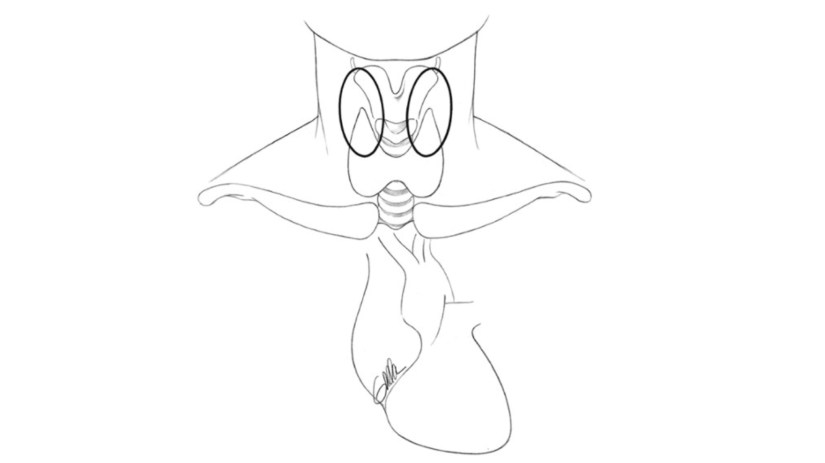
- The area of dispersal of the PIVs is limited by their short embryonic course.
- In less than 1% of the cases:
- They may be located higher, above the upper thyroid pole.
- Rarely (up to 3% to 4% of the cases):
- Normal PIVs are found more posterior in the neck in a retropharyngeal or retroesophageal location:
- Whereas pathologically enlarged parathyroid glands may be found in a retropharyngeal of retroesophageal position in up to one third of the cases:
- As the result of migration related to the parathyroid weight.
- Whereas pathologically enlarged parathyroid glands may be found in a retropharyngeal of retroesophageal position in up to one third of the cases:
- Normal PIVs are found more posterior in the neck in a retropharyngeal or retroesophageal location:
- Major ectopic locations of PIV are rare:
- They may result from descent failure or laterally directed descent:
- May lead to a superior parathyroid gland adjacent to the common carotid artery.
- A rare case of a superior parathyroid adenoma located in the scalene fat pad lateral to the carotid has been described.
- These locations account for less than 1% of the cases.
- They may result from descent failure or laterally directed descent:
- Superior parathyroid glands are sometimes found in a subcapsular position or hidden by a cleft of thyroid capsule:
- True intrathyroidal superior glands are rare and less frequent than PIII, even if the PIV may become included within the thyroid at the time of fusion of the ultimobranchial bodies with the median thyroid rudiment.
- If the superior parathyroid primordium fails to separate from the remaining endoderm of the fourth pharyngeal pouch, it may migrate to a retropharyngeal location with the pyriform sinus primordium:
- A few cases of pathologic parathyroid glands localized in the pyriform sinus have been described
- The inferior parathyroid gland (PIII):
- As the pathway of embryologic descent of the thymus extends from the angle of mandible to the pericardium:
- Anomalies of migration of the parathymus complex, whether excessive or deficient, are responsible for high or low ectopias of PIIIs.
- When the parathymus complex fails to descend fully:
- The inferior parathyroid may become stranded high in the neck:
- Typically along the carotid sheath:
- Thus, during parathyroid exploration if the inferior gland is missing:
- It is usually found with a fragment of thymic tissue above the thyroid gland and superior to the PIV.
- Thus, during parathyroid exploration if the inferior gland is missing:
- Often the gland is situated adjacent to the carotid bifurcation, approximately 2 cm to 3 cm lateral to the thyroid superior pole.
- Typically along the carotid sheath:
- The undescended PIII can be found even higher in the neck, above the carotid bifurcation, adjacent to the angle of the mandible, near the hyoid bone.
- In all these cases, the superior thyroid vessels would provide vascularization.
- The incidence of this high ectopia resulting from defective embryologic descent of the parathymus does not seem to exceed 1% to 2%.
- In all these cases, the superior thyroid vessels would provide vascularization.
- The inferior parathyroid may become stranded high in the neck:
- As the pathway of embryologic descent of the thymus extends from the angle of mandible to the pericardium:
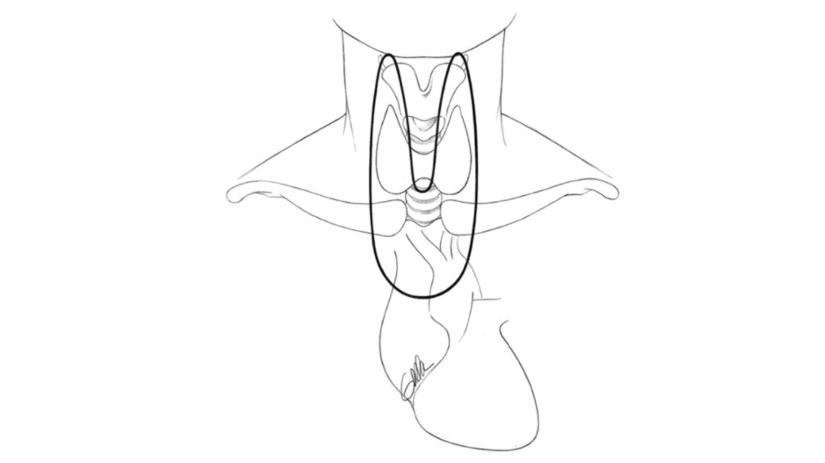
- On the other hand if the separation from the thymus is delayed:
- The PIII may be pulled down in the anterior mediastinum to a varying degree:
- In approximately 4% to 5% of cases, the inferior parathyroid gland is situated in the chest, within the retrosternal thymus, or at the posterior aspect of its capsule or in contact with the great mediastinal vessels (the innominate vein and ascending aorta):
- Only a few are located outside the thymus adjacent to the aortic arch and the origin of the great vessels.
- An even lower position results in the inferior parathyroid being in contact with the pleura or pericardium.
- In approximately 4% to 5% of cases, the inferior parathyroid gland is situated in the chest, within the retrosternal thymus, or at the posterior aspect of its capsule or in contact with the great mediastinal vessels (the innominate vein and ascending aorta):
- Most of the ectopic PIIIs, which descend below the level of the innominate vein and aortic arch:
- Develop an ectopic arterial blood supply:
- Generally, this is derived from the internal mammary artery.
- Occasionally the blood supply may come from a thymic artery or a direct branch from the aorta.
- Develop an ectopic arterial blood supply:
- The PIII may be pulled down in the anterior mediastinum to a varying degree:
- The inferior parathyroid gland is truly intrathyroidal:
- Within the lower pole of thyroid in 1% to 3% of individuals
Rodrigo Arrangoiz MS, MD, FACS a head and neck surgeon / endocrine surgeon / surgical oncologist and is a member of Sociedad Quirúrgica S.C at the America British Cowdray Medical Center in Mexico City:
-
He is an expert in the management parathyroid diseases.
-
Publication on parathyroid embryology and anatomy:
-
Parathyroid Embryology, Anatomy, and Pathophysiology of Primary Hyperparathyroidism:
-
Arrangoiz, R., Cordera, F., Caba, D., Juárez, M.M., More- no, E. and Luque, E. (2017) Parathyroid Em- bryology, Anatomy, and Pathophysiology of Primary Hyperparathyroidism. International Journal of Otolaryngology and Head & Neck Surgery, 6, 39-58.https://doi.org/10.4236/ijohns.2017.64007
-
-
Training:
• General surgery:
• Michigan State University:
• 2004 al 2010

• Surgical Oncology / Head and Neck Surgery / Endocrine Surgery:
• Fox Chase Cancer Center (Filadelfia):
• 2010 al 2012

• Masters in Science (Clinical research for health professionals):
• Drexel University (Filadelfia):
• 2010 al 2012

• Surgical Oncology / Head and Neck Surgery / Endocrine Surgery:
• IFHNOS / Memorial Sloan Kettering Cancer Center:
• 2014 al 2016

#Arrangoiz#Teacher
#Surgeon
#Cirujano
#ThyroidExpert
#ThyroidSurgeon
#CirujanodeTiroides
#ExpertoenTiroides
#ExpertoenParatiroides
#Paratiroides
#Hiperparatiroidismo
#CancerdeTiroides
#ThyroidCancer
#PapillaryThyroidCancer

 Rodrigo Arrangoiz MS, MD, FACS, FSSO