
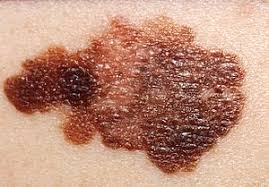
- Cutaneous malignancies constitute one of the most commonly diagnosed cancers in the United States of America (USA):
- More than half of all cancers diagnosed each year.
- In the USA, approximately 1.2 million to 1.4 million cases of skin cancer are diagnosed annually:
- The most common skin cancer types are:
- Basal cell carcinoma (BCC)
- Squamous cell carcinoma (SCC)
- Melanoma
- The most common skin cancer types are:
- In the year 2019 an estimated:
- 96, 480 new cases of melanoma will be diagnosed.
- 7230 deaths are estimated to occur in the year 2019 in the USA
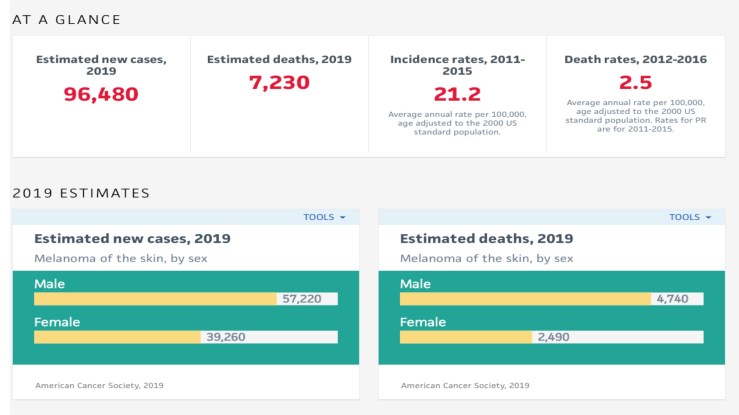
- The incidence is increasing dramatically, at an overall rate of 33% for men and 23% for women from 2002 to 2006:
- About 2.6% per year
- These estimates for new cases may represent a substantial underestimation because many superficial and in-situ melanomas treated in the outpatient setting are not reported.
- About 2.6% per year
- There will be approximately 7,230 deaths in the USA secondary to cutaneous melanoma in 2019:
- Approximately 8000 patients will be found to have metastatic melanoma at the time of diagnosis.
- Cutaneous melanoma accounts for 4% of all skin cancer diagnosis:
- But accounts for 75% of skin cancer deaths.
- The age-adjusted incidence of invasive melanoma in the USA increased from approximately 4 per 100,000 to 18 per 100,000 in white males between 1973 and 1998:
- The age-adjusted incidence of invasive melanoma in the USA increased to 21.1 per 100,000 in white males between 2011 and 2015.
- The incidence of melanoma continues to increase dramatically:
- Melanoma is increasing in men more rapidly than any other malignancy and, in women more rapidly than any other malignancy except lung cancer.
- This disturbing increase can be ascribed to prevailing social attitudes toward sun exposure.
- Melanoma is increasing in men more rapidly than any other malignancy and, in women more rapidly than any other malignancy except lung cancer.
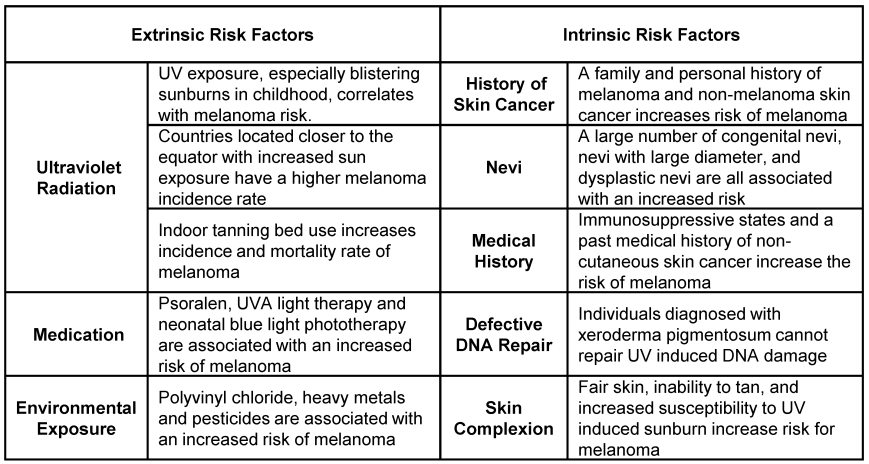
- Risk Factors for Cutaneous Melanoma:
- Risk factors for cutaneous melanoma are both genetic and environmental:
- With interaction between the two playing a critical role.
- The majority (approximately 90%) of melanoma cases are sporadic.
- The main environmental risk factor associated with cutaneous melanoma is exposure to UV radiation:
- There is sufficient evidence that too much exposure to solar UV radiation is the main cause of both malignant melanoma and non-melanoma skin cancers in humans, according to the International Agency for Research on Cancer (IARC).
- A history of more than ten severe and painful sunburns is associated with a two-fold greater risk of developing melanoma.
- Intermittent sun exposure:
- Defined as, sporadic and commonly associated with recreational activities, particularly among indoor workers who use weekend or vacation time to be outdoors and whose skin has not adapted to the sun:
- Is the most important risk factor for melanoma:
- Three systematic reviews have demonstrated similar estimates for the role of intermittent sun exposure in melanoma development (i.e., odds ratios [ORs] of 1.6 to 1.7).
- Is the most important risk factor for melanoma:
- Defined as, sporadic and commonly associated with recreational activities, particularly among indoor workers who use weekend or vacation time to be outdoors and whose skin has not adapted to the sun:
- Risk factors for cutaneous melanoma are both genetic and environmental:
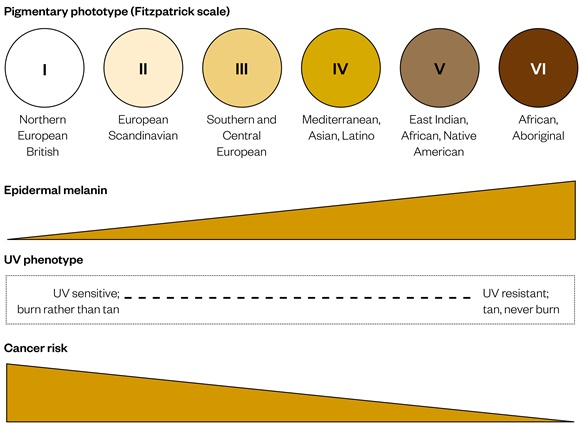
- Pigment characteristics are important determinants of melanoma susceptibility:
- There is an inverse correlation between melanoma risk and skin color that goes from lightest skin to darkest skin:
- Melanoma occurs infrequently in skin of color:
- Suggesting that skin pigment plays a protective role.
- Melanoma occurs infrequently in skin of color:
- Melanoma is 10 to 12 times more common in whites, and 6 to 7 times more common in Hispanics than in African Americans (AA).
- There is an inverse correlation between melanoma risk and skin color that goes from lightest skin to darkest skin:
- Fair complexion (Fitzpatrick skin photo-type I and II), blue or green eyes, blond or red hair, freckling are all risk factors for the development of melanoma:
- A meta-analysis reported, that in contrast with people with Fitzpatrick skin photo-type IV:
- Those with Fitzpatrick skin photo-type I are at more than double (2.27 times) the risk for developing malignant melanoma.
- Those with Fitzpatrick skin photo-type II at double (1.99 times) the risk developing malignant melanoma.
- Those with Fitzpatrick skin photo-type IIIa 35% increased risk for developing malignant melanoma.
- A meta-analysis reported, that in contrast with people with Fitzpatrick skin photo-type IV:
- People with red / red – blonde hair have triple the malignant melanoma risk compared to dark-haired people.
- People with blond hair are at double the risk for developing malignant melanoma.
- People with light brown hair are at 46% increased risk for developing malignant melanoma.
- Individuals with freckles have double (1.99 times) the risk of malignant melanoma, as opposed to people without freckles:
- These individuals with freckles have increased malignant melanoma risk, irrespective of the number of moles they have.
- Individuals with blue / green-blue /green-grey eyes are at increased risk of basal cell carcinoma (BCC), the risk for melanoma is less well known.
Rodrigo Arrangoiz MS, MD, FACS a head and neck / surgical oncologist and is a member of Sociedad Quirúrgica S.C at the America British Cowdray Medical Center in Mexico City:
-
He is an expert in the management of skin cancer including MELANOMA.
-
If you have any questions about the management of melanoma please fill free to contact Dr. Arrangoiz.
-
Article on Melanoma published by Dr. Arrangoiz:
-



 Rodrigo Arrangoiz MS, MD, FACS, FSSO