
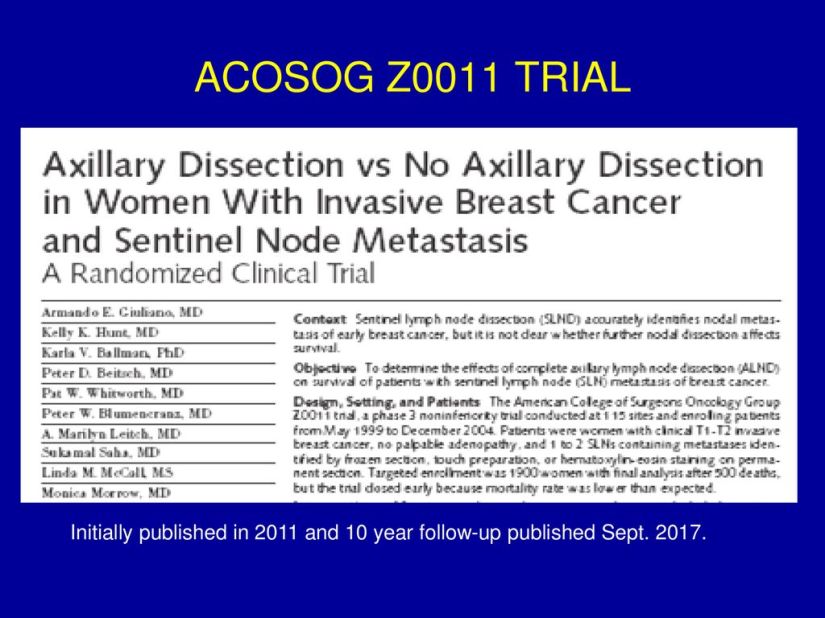
- Traditionally, axillary lymph node dissection (ALND) was performed in the setting of a positive Sentinel Lymph Node (SLN):
- A paradigm shift occurred in 2010 following results of the ACOSOG Z0011 trial which challenged the traditional approach:
- This trial definitively changed the management of SLN positive axillary metastases in patients with early-stage clinically node-negative breast cancer.
- The Z0011 trial enrolled patients with:
- Clinically node-negative
- T1 or T2 early-stage breast cancer undergoing breast conservation therapy (BCT) and SLN dissection
- With three or fewer positive SLNs as detected by hematoxylin and eosin (H&E) staining.
- Critically important to this study was the requirement that:
- All patients received postoperative whole breast radiation and chemotherapy as indicated.
- Patients were randomized to completion axillary dissection versus no further axillary surgery.
- At a median follow-up of 6.3 years:
- There was no difference in overall survival:
- ALND 91.9% vs. 92.5% in SLN-only (P = 0.24)
- There was no difference in disease free survival at 5 years:
- ALND 82.2% vs. 83.8% in SLN-only (P = 0.13)
- There was no significant difference in local recurrence:
- 3.6% of the ALND group versus 1.8% of the SLND-only group.
- After ALND alone:
- Ipsilateral axillary recurrence was identified in 0.5% of patients
- After SLNB alone:
- Ipsilateral axillary recurrence was identified in 0.9%
- There was no difference in overall survival:
- Although this study closed early due to poor accrual:
- Results suggest that in clinically node-negative patients with early-stage breast cancer who will receive whole breast radiotherapy and systemic adjuvant therapy as indicated, ALND does not confer an improved survival advantage:
- In this setting SLN dissection alone for appropriate staging with completed adjuvant therapy may offer excellent regional control with decreased morbidity.
- Results suggest that in clinically node-negative patients with early-stage breast cancer who will receive whole breast radiotherapy and systemic adjuvant therapy as indicated, ALND does not confer an improved survival advantage:
- Since the publication of these practice-changing results,:
- The Z0011 findings have been rapidly and widely adopted and are now considered standard practice.
- It is important to note that these findings are not applicable to all patients including:
- Those with locally advanced (T3 or T4) disease
- Those who received neoadjuvant chemotherapy
- Those undergoing mastectomy
- A paradigm shift occurred in 2010 following results of the ACOSOG Z0011 trial which challenged the traditional approach:
Rodrigo Arrangoiz MS, MD, FACS a surgical oncologist and is a member of Sociedad Quirúrgica S.C at the America British Cowdray Medical Center in Mexico City:
-
He is an expert in the management of breast cancer.
-
If you have any questions about the management of Sentinel Lymph Node (SLN) positive breast cancer patients please fill free to contact Dr. Arrangoiz.
-
Training:
• General surgery:
• Michigan State University:
• 2004 al 2010

• Surgical Oncology / Head and Neck Surgery / Endocrine Surgery:
• Fox Chase Cancer Center (Filadelfia):
• 2010 al 2012

• Masters in Science (Clinical research for health professionals):
• Drexel University (Filadelfia):
• 2010 al 2012

• Surgical Oncology / Head and Neck Surgery / Endocrine Surgery:
• IFHNOS / Memorial Sloan Kettering Cancer Center:
• 2014 al 2016

#Arrangoiz
#Surgeon
#Cirujano
#SurgicalOncologist
#CirujanoOncologo
#BreastSurgeon
#CirujanodeMama
#CancerSurgeon
#CirujanodeCancer
http://www.sociedadquirurigca.com


 Rodrigo Arrangoiz MS, MD, FACS, FSSO