
A. Introduction:
Carcinoma of the buccal mucosa is relatively uncommon in North America, compared with other oral cavity cancers such as carcinomas of the oral tongue or floor of the mouth:
-
Squamous cell carcinoma (SCC) is the most common pathology (greater than 90% of all oral cavity cancers) and more prevalent in those who use tobacco and alcohol.
As the orifice of the upper aerodigestive tract, the oral cavity plays a critical role in breathing, speech, and swallowing:
-
The buccal region is particularly important in bolus formation, preventing food from spilling into the lateral oral gutters or extra-orally during the oral preparatory phase of swallowing:
-
Cancer of the buccal mucosa and subsequent treatment of the disease may interfere with these functions.
-
Buccal carcinoma has the propensity to become aggressive, with high rates of local and regional recurrence.
-
Diagnosis and treatment at an early stage leads to significantly improved prognosis and function over advanced disease.
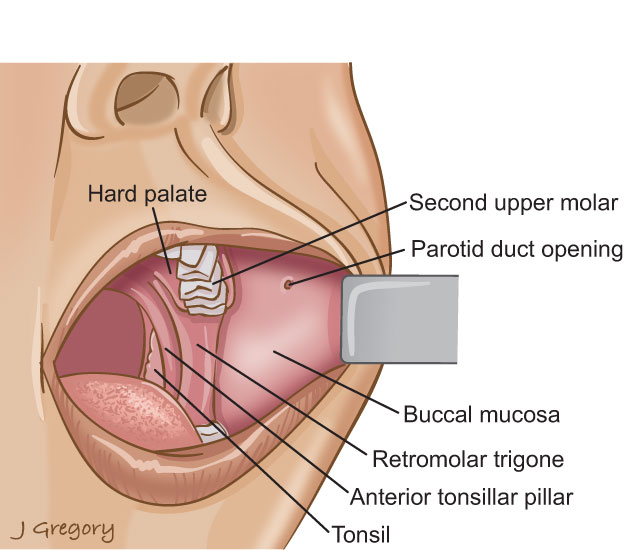
B. Epidemiology:
-
SCC of the buccal mucosa accounts for approximately 5% to 10% of all cancers of the oral cavity in North America and Western Europe.
-
It occurs more often in men:
-
With a male to female ratio of 3 to 4:1
-
-
It is diagnosed most commonly in the 7th or 8th decade of life (in the USA).
-
The incidence of buccal carcinoma is much higher in Asia:
-
In Southeast Asia, the disease is the most common form of oral cavity cancer (in the USA it is tongue cancer).
-
In India, buccal carcinoma is the most common cancer in men and the third most common cancer in women.
-
The higher rate of buccal carcinoma in Asia is likely related to the widespread practice of betel nut chewing:
-
Betel nut, composed mainly of the fruit of the Areca Palm and often mixed with tobacco, is placed along the buccal mucosa to induce a feeling of euphoria:
-
Buccal carcinoma related to betel nut chewing tends to develop at an earlier age, with most cases occurring between the ages of 40 to 70.
-
-
-
-
C. Etiology:
-
Tobacco and alcohol use are the main etiologic agents associated with the development of buccal carcinoma:
-
In North America, a history of using tobacco is documented in 70% of patients.
-
-
Although alcohol by itself is not thought to be a significant risk factor, tobacco and alcohol have a well-recognized synergistic effect in the development of carcinoma.
-
In Asia, betel nut is a significant etiologic agent, in addition to tobacco and alcohol.
-
In India, over 90% of patients with buccal carcinoma have a history of using betel nut.
-
Other suspected but not confirmed etiologic agents include poor oral hygiene, and chronic irritation.
-
Premalignant conditions include submucosal fibrosis and lichen planus:
-
The latter has a reported transformation rate of 0.5% to 3%, whereas the former has a malignant transformation rate of 0.5%.
-
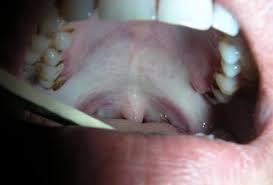
D. Presentation:
-
Buccal SCC commonly presents as a slow-growing mass on the buccal mucosa.
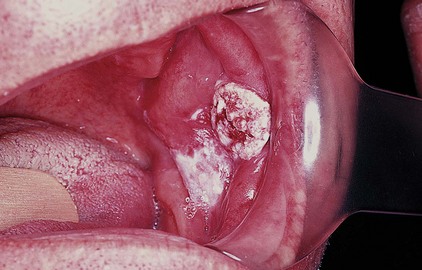
- Synchronous SCC of the buccal mucosa
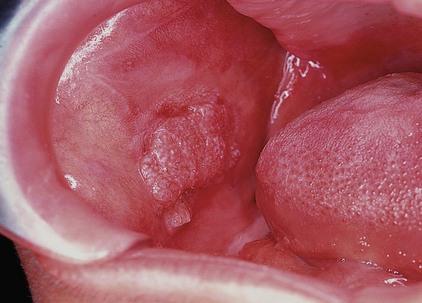
- Papillary SCC of the buccal mucosa
-
Small lesions tend to be asymptomatic and are often noted incidentally on dental examination.
-
Pain commonly occurs as the lesion enlarges and ulceration develops.
-
Oral intake may worsen the pain and lead to malnutrition and dehydration.
-
Associated symptoms include:
-
Bleeding, poor denture fit, facial weakness or sensory changes, dysphagia, odynophagia, and trismus.
-
Rodrigo Arrangoiz MS, MD, FACS a head and neck surgeon and is a member of Sociedad Quirúrgica S.C at the America British Cowdray Medical Center.
He is first author on some publications on oral cavity cancer:
-
Oral Tongue Cancer: Literature Review and Current Management
-
Understand Cancer: Research and Treatment Oral Cavity Cancer: Literature Review and Current Management.





 Rodrigo Arrangoiz MS, MD, FACS, FSSO