EPIDEMIOLOGY AND ETIOLOGY OF MEDULLARY THYROID CARCINOMA
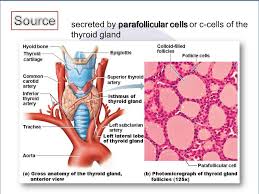
Medullary thyroid carcinoma (MTC) is a neuroendocrine tumor of the para-follicular cells or C cells of the thyroid gland.

Unknown

Approximately 1.7% of all thyroid neoplasms are medullary carcinomas. Although most cases are sporadic, 15% to 25% of the cases are part of an autosomal dominant hereditary syndrome.

Unknown-1

The production of calcitonin is a characteristic feature of this tumor. The C cells originate in the embryonic neural crest; as a result, medullary carcinomas often have the clinical and histological characteristics of other neuroendocrine tumors such as carcinoids and pancreatic islet cell tumors.

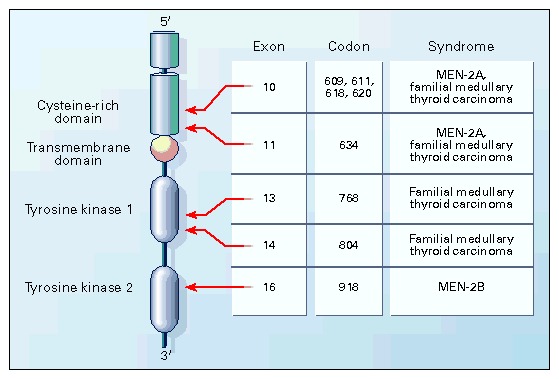
The RET protooncogene (RE- arranged during Transfection) was discovered in 1985 by Takahashi et al. The RET protooncogene is expressed in cells derived from the neural crest, the branchial arches, and the urogenital system. It is located on chromosome 10q11.2, encodes a single-pass transmembrane receptor of the tyrosine kinase family.

nejm199609263351307_f3

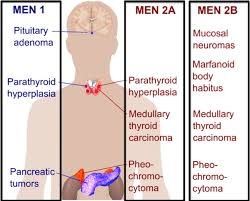
Soon after this discovery it was found that nearly all patients with MEN2A, MEN2B, and familial medullary thyroid cancer (FMTC) have RET germline mutations and roughly 50% of sporadic MTCs have somatic RET mutations.

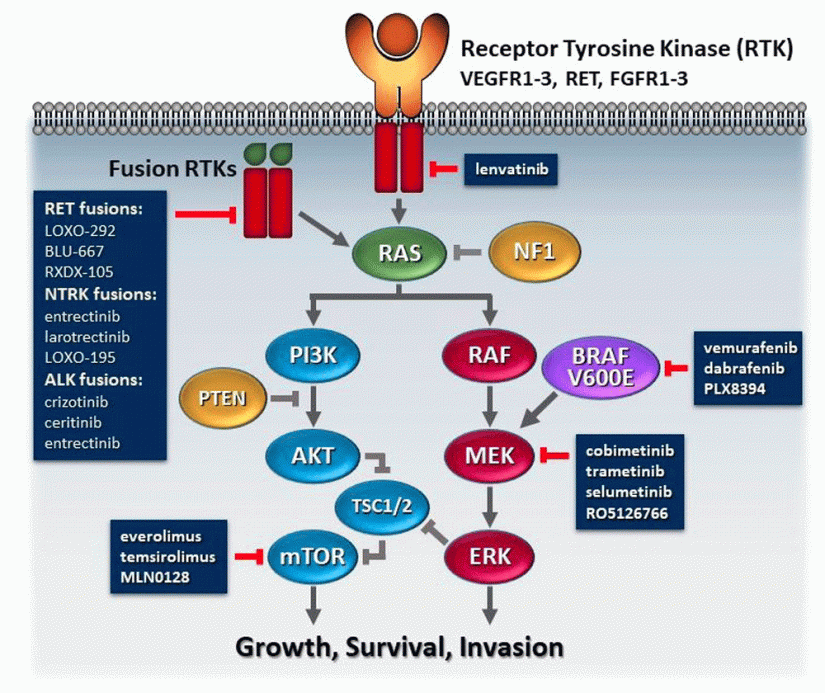
Researchers recently revealed that 18% to 80% of sporadic MTCs lacking somatic RET mutations have somatic mutations of HRAS, KRAS, or rarely NRAS [17-19].

8fb25e2b-e511-4643-a84b-fe9b1b6180fd_figure2

The probability that an apparently sporadic case of MTC is familial should be considered preoperatively. Despite the absence of a family history of MTC, germline mutations in the RET proto-oncogene have been identified in less than 10% of cases of a seemingly sporadic MTC (index cases) [20, 21].

In sporadic MTC the somatic RET codon M918T mutation appears to indicate an aggressive clinical course and a poor prognosis. Romei C et al reviewed 160 patients with sporadic MTC and found that the  prevalence of somatic RET codon M918T mutations varied depending on tumor size: < 1 cm, 11.3% of the cases; 1 to 2 cm, 11.8% of the cases; 2 to 3 cm, 31.8% of the cases; and > 3 cm, 58.8% of the cases. The results of these study raise the question of whether RET acts singlehandedly as the initiator of oncogenesis in sporadic MTC or is activated later as a driver of tumor growth, with other genes playing a significant role in MTC onset. Another reason for these findings is that M918T mutated tumors have a higher growth rate and are more likely to be identified when they are bigger. The low prevalence of the M918T mutation in microcarcinomas may signify a different entity such as carcinoma in situ; precisely because it is not driven by RET.

Several guidelines for the management of sporadic and hereditary MTC have been published by several groups including the North American Neuroendocrine Tumor Society, the National Comprehensive Cancer Network, and the American Thyroid Association (ATA).

Medullary-Thyroid-Ca-ATA-v3a-cover-800px-191x300

These guidelines described the disease phenotypes associated with specific RET mutations in hereditary MTC and recommended timing of early thyroidectomy based on the specific RET mutation. Three of the guidelines used either the TNM designation of the American Joint Committee on Cancer (AJCC), or terms such as Level I, II, or III, or ‘‘high,’’ ‘‘higher,’’ or ‘‘highest,’’ to allocate progressive increases in aggressiveness of the MTC. The criteria used to categorize the aggressiveness of the disease was the development of MTC at an early age, frequently in association with metastatic disease. The original ATA guidelines used A, B, C, and D designations to define categories of RET mutations associated with increasing aggressiveness of the MTC.

Due to significant misunderstanding regarding the different ATA risk categories, the task force recommends that the A and B categories be combined into a new category, ‘‘moderate risk’’ (MOD); category C be changed to a new category, ‘‘high risk’’ (H); and category D be changed to a new category, ‘‘highest risk’’ (HST) [recommendation # 1 from the ATA guidelines). The ATA-HST category includes patients with MEN2B and the RET codon M918T mutation, the ATA-H category includes patients with RET codon C634 mutations and the RET codon A883F mutation, and the ATA- MOD category includes patients with RET codon mutations other than M918T, C634, and A883F. Ever since the discovery of the RET oncogene, over 100 mutations, duplications, insertions, or deletions involving RET protooncogene have been identified in patients with hereditary MTC.

El entrenamiento de Rodrigo Arrangoiz MS, MD, FACS experto en tumores de tiroides fue el siguiente:

• Cirugia general y gastrointestinal:

• Michigan State University:

• 2004 al 2010

• Cirugia oncológica / tumores de cabeza y cuello / cirugia endocrina:

• Fox Chase Cancer Center (Filadelfia):

• 2010 al 2012

• Maestria en ciencias (Clinical research for health professionals):

• Drexel University (Filadelfia):

• 2010 al 2012

• Cirugia de tumores de cabeza y cuello / cirugia endocrina

• IFHNOS / Memorial Sloan Kettering Cancer Center:

• 2014 al 2016

Leave a comment