
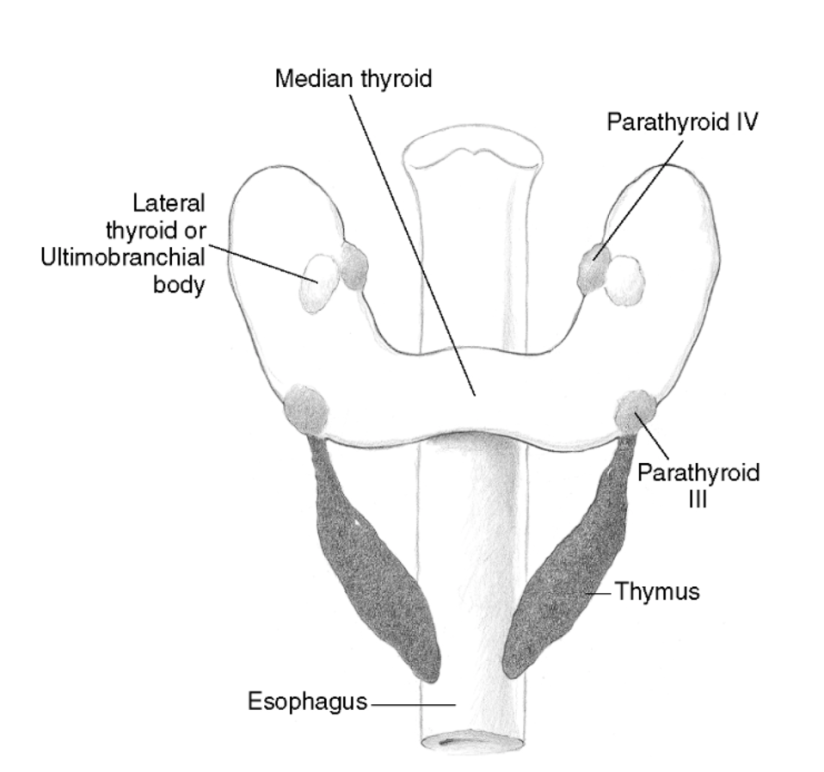
The initial thyroid precursor, the thyroid primordium, starts as a simple midline thickening (endoderm) and develops to form the thyroid diverticulum or thyroid anlage (this median anlage forms the bulk of the thyroid gland).
- This structure at the outset is initially hollow, though it later solidifies (forming the follicular elements of the thyroid gland) and becomes bilobed.
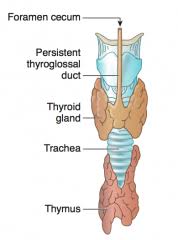
Division of the thyroid gland into lateral lobes, if not present from the beginning, takes place so early that it is impossible to establish whether the thyroid arises as a single unit or as a paired organ. The stalk usually has a lumen, the thyroglossal duct, that does not descend into the lateral lobes. The two lobes are located on either side of the midline and are connected via an isthmus.
- This thyroid anlage follows the primitive heart as it descends caudally.
Early during the fifth week of gestation, the attenuated duct loses its lumen and subsequently breaks into fragments.
- The proximal part retracts and vanishes, leaving only the foramen cecum at the base of the tongue to mark its origin, and the caudal end develops as the bilobed encapsulated thyroid gland and reaches its final adult position by the 7thweek of gestation.
The paired lateral anlages originate from the ventral portions of the fourth and fifth branchial pouches and fuse with the median thyroid anlage at approximately the fifth week of gestation, contributing up to 30% of the thyroid gland weight.
- The lateral anlages are neuroectodermal / neural crest in origin (ultimobranchial bodies) and produce the calcitonin producing parafolicullar or C cells (from the neural crest these the C-cells migrate to the ultimobranchial bodies), which come to lie in the superior posterior region of the thyroid gland.
The fusion of the median thyroid anlage and the ultimobranchial bodies explains why the parafollicular cells or C cells are not scattered throughout the entire thyroid but are limited to a region deep within the middle to upper thirds of the lateral lobes along an imaginary central lobar axis.
- The bases for the fusion of the median and lateral thyroid anlages is unclear, but the site of the fusion of these two structures is stated to occur at the tubercle of Zuckerkandl.
- The parafolicullar or C cells belong to a group of neural-crest derivatives known as the amine precursor uptake and decarboxylation cells (APUD).
Michigan State University
Drexel University
Hospital ABC Santa Fé
Av. Carlos Graef Fernández #154
Col. Tlaxala, Delg. Cuajimalpa
México, D.F. 05300
Tel: 1103 – 1600 Ext 4515 a la 4517
Fax:1664 – 7164

 Rodrigo Arrangoiz MS, MD, FACS, FSSO