
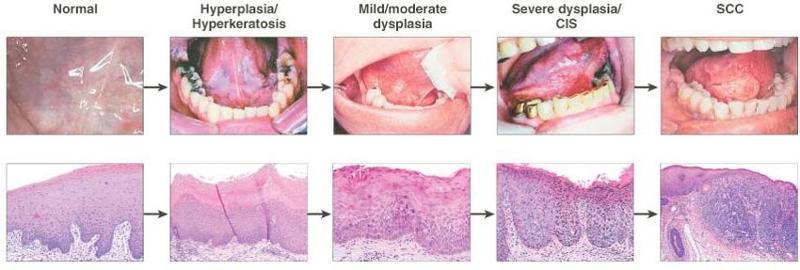
A. There is a sequence of disease progression from atypia / dysplasia through carcinoma in situ to frankly invasive cancer:
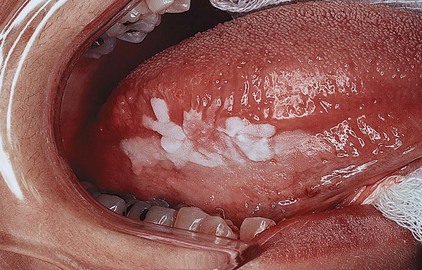
1. Leukoplakia and erythroplakia are terms applied to clinically identifiable lesions that may harbor invasive cancer or undergo malignant transformation.
B. Pathology:
1. Leukoplakia results from chronic irritation of mucous membranes:
– This irritation stimulates the proliferation of white epithelial and connective tissue.
– Histopathologic examination reveals hyperkeratosis variably associated with underlying epithelial hyperplasia.
– In the absence of underlying dysplasia, leukoplakia rarely (less 5% of the cases) is associated with progression of disease to malignancy.
2. Erythroplakia is characterized by superficial, friable, red patches adjacent to normal mucosa.
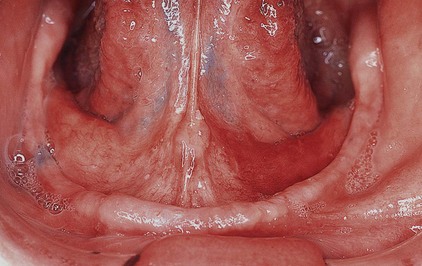
– It is commonly associated with underlying epithelial dysplasia and has a much greater potential for malignancy than leukoplakia.
– Carcinoma is found in nearly 40% of erythroplakia cases.
3. Dysplasia is characterized by cellular atypia, loss of normal maturation, and loss of normal epithelial stratification.
– It is graded as mild, moderate, or severe, based on the degree of nuclear abnormality present.
– In the transition from mild to severe dysplasia, nuclear abnormalities become more marked, mitoses become more apparent, and these changes involve increasing depth of the epithelium.
– The likelihood of developing a carcinoma relates to the degree of dysplasia:
= In the case of severe dysplasia, as many as 24% of patients may develop invasive squamous cell cancer.
4. Carcinoma in situ is characterized by the presence of atypical changes throughout the epithelium, with complete loss of stratification.
– It is estimated that approximately 75% of invasive squamous cell carcinomas have an associated in situ component.
– Specific DNA mutations have also been identified in the sequence of disease progression from mild dysplasia to atypia to carcinoma in situ to invasive carcinoma.
Cirugía General y Gastrointestinal
Michigan State University
Cirugía Oncológica
Drexel University
Certificado por el Colegio Americano de Cirugía
Sociedad Quirúrgica S.C.
Hospital ABC Santa Fé
Av. Carlos Graef Fernández #154
Col. Tlaxala, Delg. Cuajimalpa
México, D.F. 05300
Tel: 1103 – 1600 Ext 4515 a la 4517
Fax:1664 – 7164

 Rodrigo Arrangoiz MS, MD, FACS, FSSO