
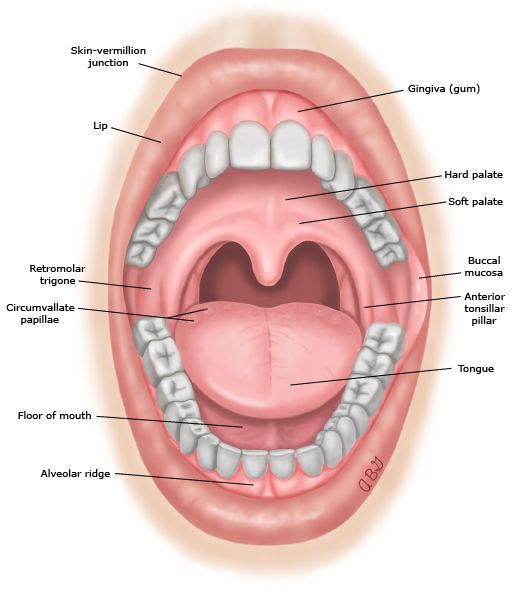
The oral cavity represents the entrance to the upper aerodigestive tract, which begins at the lips and ends at the anterior surface of the faucial arch.
-
It is lined by squamous epithelium with interspersed minor salivary glands.
The oral cavity also contains the dentoalveolar structures with the upper and lower dentition.
The oral cavity is continuously exposed to inhaled and consumed carcinogens, and thus it is the most common site for the origin of malignant epithelial neoplasms in the head and neck region.
Known carcinogens in the oral cavity include those present in tobacco, alcohol, and betel nuts.
-
The association of human papilloma virus with oral cancer is not as well established as in oropharyngeal cancers.
Epidemiology
-
The estimated incidence of oral cavity cancer in the USA in 2018 – 33 950 cases:
-
Tongue 17, 110 cases
-
Mouth 13, 580 cases
-
Other oral cavity sites 3260 cases
-
-
The estimated mortality for oral cavity cancer in the USA in 2018 – 5160 deaths
Rodrigo Arrangoiz MS, MD, FACS
Cirugía General y Gastrointestinal
Michigan State University
Cirugía Oncológica
Michigan State University
Cirugía Oncológica
Fox Chase Cancer Center
Tumores de Cabeza y Cuello / Cirugía Endocrina
Fox Chase Cancer Center
Tumores de Cabeza y Cuello / Cirugía Endocrina
IFHNOS / Memorial Sloan Kettering Cancer Center
Maestría en Ciencias de Investigación
Drexel University
Certificado por el Colegio Americano de Cirugía
Drexel University
Certificado por el Colegio Americano de Cirugía
Fellow del Colegio Americano de Cirugía
Fellow de la Sociedad de Cirugia Oncológica
Sociedad Quirúrgica S.C.
Hospital ABC Santa Fé
Av. Carlos Graef Fernández #154
Sociedad Quirúrgica S.C.
Hospital ABC Santa Fé
Av. Carlos Graef Fernández #154
Consultorio 515
Col. Tlaxala, Delg. Cuajimalpa
México, D.F. 05300
Tel: 1103 – 1600 Ext 4515 a la 4517
Fax:1664 – 7164
Col. Tlaxala, Delg. Cuajimalpa
México, D.F. 05300
Tel: 1103 – 1600 Ext 4515 a la 4517
Fax:1664 – 7164

 Rodrigo Arrangoiz MS, MD, FACS, FSSO