
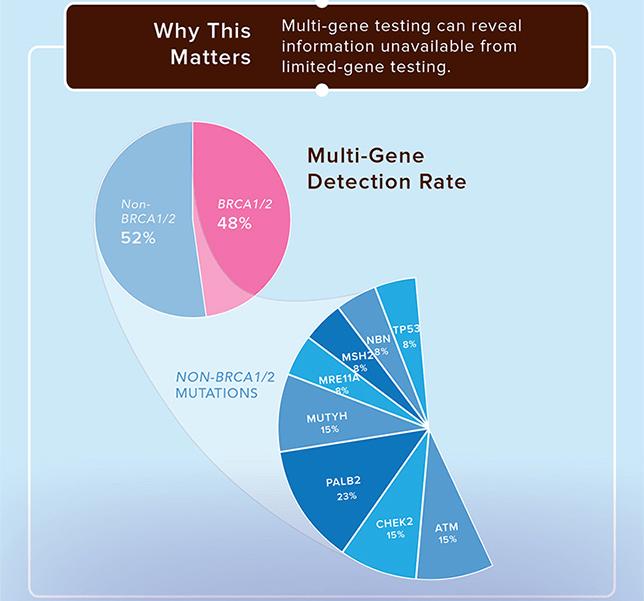
Multi-gene panel testing will identify a pathogenic mutation in 4% to 12% of familial high-risk patients who have tested negative for BRCA1 and BRCA2 mutation.
- BRCA1 and BRCA2 are still the genes most frequently implicated in hereditary breast cancer predisposition:
- PALB2, CHEK2, and ATM are the next most common.
Variants of uncertain clinical significance are reported for 20% to 40% of tests.
- This is likely to improve as data accumulate.
Average cancer risk can be estimated for most of the genes, but this should be adjusted up or down based on family history for management decisions.
Most patients with a pathologic mutation in any of the breast cancer predisposition genes meet the criteria for enhanced surveillance with magnetic resonance imaging.
Risk-reducing surgery is considered for the highest-risk patients.
The results of a genetic test can influence management decisions for the newly diagnosed breast cancer patient.
Rodrigo Arrangoiz MS, MD, FACS
Cirugía General y Gastrointestinal
Michigan State University
Michigan State University
Cirugía Oncológica
Fox Chase Cancer Center
Tumores de Cabeza y Cuello / Cirugía Endocrina
Fox Chase Cancer Center
Tumores de Cabeza y Cuello / Cirugía Endocrina
IFHNOS / Memorial Sloan Kettering Cancer Center
Maestría en Ciencias de Investigación
Drexel University
Drexel University
Certificado por el Colegio Americano de Cirugía
Fellow del Colegio Americano de Cirugía
Fellow de la Sociedad de Cirugia Oncológica
Sociedad Quirúrgica S.C.
Hospital ABC Santa Fé
Av. Carlos Graef Fernández #154
Hospital ABC Santa Fé
Av. Carlos Graef Fernández #154
Consultorio 515
Col. Tlaxala, Delg. Cuajimalpa
México, D.F. 05300
Tel: 1103 – 1600 Ext 4515 a la 4517
Fax:1664 – 7164
Col. Tlaxala, Delg. Cuajimalpa
México, D.F. 05300
Tel: 1103 – 1600 Ext 4515 a la 4517
Fax:1664 – 7164

 Rodrigo Arrangoiz MS, MD, FACS, FSSO